
Clinical Evidence
Explore trials and studies for the BioProtect Balloon Spacer.
BioProtect is supported by a randomized controlled trial and multi-center clinical studies demonstrating significant rectal dose reduction, low toxicity rates, and preservation of patient-reported quality of life.1,2
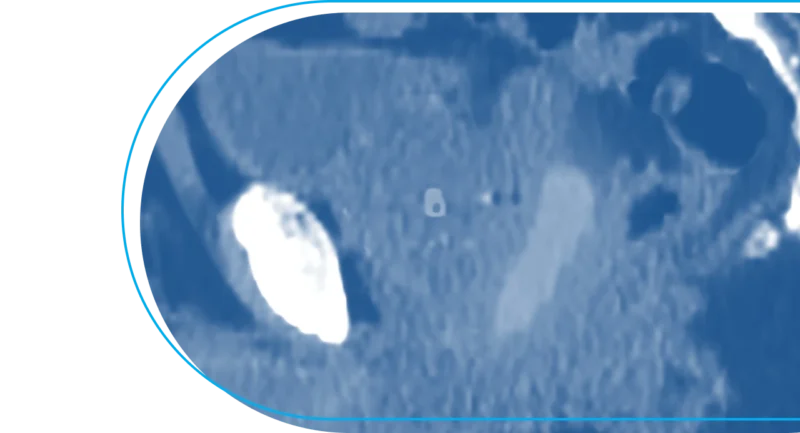
Proven Efficacy and Safety
BioProtect was evaluated in a pivotal prospective multicenter randomized controlled subject-blind phase III trial, published in the International Journal of Radiation Oncology, Biology, Physics.1 Utilizing a two-to-one ratio of BioProtect to control, 222 men with T1-T3 prostate cancer were assessed at 16 sites.1 Efficacy and safety were co-primary trial endpoints, with prostate-rectal wall separation and patient-reported quality of life as secondary endpoints.1
Pivotal Trial Outcomes
achieved >25% rectal V70 reduction (p < 0.001).1
of the prostate and rectum at placement (mean), with 18 ± 3.9 mm mean at last radiation.1
demonstrated balloon resorption at 6 months.1
Linked Pivotal Trial Analysis


Clinical Studies
BioProtect has been evaluated in over 20 studies appearing in peer-reviewed journals, including comparisons with gel-based spacers across a variety of treatment modalities.
Comparative Efficacy Study
Results: BioProtect achieved significantly greater mean rectal V70 reduction than SpaceOAR in conventional fractionation, with rectal dose reductions observed across all dose levels in both conventional and ultra hypofractionated regimens.3
Design: A multicenter, double-arm, central core lab retrospective study compared BioProtect with SpaceOAR gel spacer.3 Utilizing conventional fractionation and ultra hypofractionated treatment plans with a two-to-one BioProtect to gel spacer ratio, the study assessed the rectal dosimetry of 59 men across five centers.3
Efficacy Results
| BioProtect Balloon Spacer (n=24) | SpaceOAR (n=35) | |
|---|---|---|
| Conventional fractionation rV70 dose reduction | 84.1% | 67.0% |
| Ultrahypofractionation rV31.7 dose reduction | 84.1% | 68.1% |
Apical Spacing Comparative Study
Results: BioProtect achieved anterior-posterior spacing that was significantly greater than a PEG gel spacer at the apex, mid-gland, and base of the prostate (p<0.001).4
Design: A retrospective dual-arm comparative study of geometry, symmetry, rectal dosimetry, and GI/GU toxicity evaluated BioProtect and a PEG gel spacer with 67 subjects.4
Apical Spacing Results
| BioProtect Balloon Spacer (n=33) | SpaceOAR (n=34) | |
|---|---|---|
| Apical symmetry achieved | 54.5% | 44.1% |
| No apical coverage | 0% | 8.8% |
| Optimal symmetry | 33.3% | 14.7% |
Anatomical-Level Separation and Dosimetry SBRT Study
Results: Sufficient prostate-rectum separation from apex to base is associated with lower dose to organs at risk. Apical separation ≥14 mm is associated with reduced rectal and penile bulb dose, and base separation ≥14 mm is associated with reduced bladder dose.5
Design: Retrospective cohort evaluating anatomical-level prostate–rectum separation achieved with a biodegradable balloon spacer and associated organ-at-risk dosimetry with 33 subjects treated with SBRT (36.25 Gy / 5 fractions).5
Prostate-Rectum Separation (Overall Mean Separation: 16.6 mm)
| % Subjects | |
|---|---|
| Apex ≥14 mm | 67% |
| Mid-Gland ≥14 mm | 70% |
| Base ≥14 mm | 61% |
≥14 mm Separation Associated with Lower OAR Dose vs. <14 mm Separation
| Location | Organ | Mean Dose Reduction |
|---|---|---|
| Apex | Rectum | 5.49 Gy (p<0.001) |
| Apex | Penile Bulb | 4.36 Gy (p<0.001) |
| Base | Bladder | 3.07 Gy (p=0.025) |
Proton Therapy Comparative Study
Results: BioProtect achieved significantly greater mid-gland and apical prostate–rectum separation. BioProtect also achieved significantly lower rectal V60 in prostate-only and whole-pelvis plans. No rectal wall infiltration events were observed in the BioProtect cohort, compared with three events in the Barrigel cohort.6
Design: Retrospective comparative study evaluating geometric separation, rectal dosimetry, rectal wall infiltration, and early GI toxicity with a BioProtect balloon spacer vs. hyaluronic acid hydrogel spacer (Barrigel) in 50 patients treated with proton therapy.6
Mean Separation, Dose Reduction & Toxicity
| BioProtect Balloon Spacer (n=25) | Barrigel (n=25) | |
|---|---|---|
| Mid-Gland Separation (p<0.01) | 18.28 mm | 14.52 mm |
| Apical Separation (p<0.001) | 12.8 mm | 8.3 mm |
| rV60 (Prostate-Only) (p<0.01) | 2.02% | 6.69% |
| rV60 (Whole-Pelvis) (p<0.01) | 1.60% | 4.72% |
| Grade ≥2 GI Toxicity (3 Months) | 0% | 17.4% |
LDR Brachytherapy Comparative Study
Results: BioProtect demonstrated the greatest reduction in rectal dose among evaluated spacing modalities in low-dose-rate (LDR) brachytherapy. BioProtect also achieved significantly greater rectoprostatic separation at the base, mid-gland, and apex compared with PEG hydrogel (SpaceOAR) and hyaluronic acid (Barrigel) spacers.7
Design: Retrospective comparative study evaluating rectoprostatic separation and rectal dosimetry across rectal spacer types in 53 subjects undergoing LDR brachytherapy.7
Separation & Dose Reduction
| BioProtect Balloon Spacer (n=15) | SpaceOAR (n=19) | Barrigel (n=11) | |
|---|---|---|---|
| Mean Base Separation | 17.0 mm | 13.4 mm | 9.7 mm |
| Mean Mid-Gland Separation | 15.5 mm | 10.5 mm | 9.2 mm |
| Mean Apical Separation | 13.3 mm | 6.3 mm | 6.5 mm |
| Median Rectal D1cc | 13.8% | 33.0% | 25.4% |
| Median Rectal D2cc | 11.8% | 24.1% | 20.5% |
Learn More About BioProtect
Considering using BioProtect in your practice? Let’s talk.